
1. The Direct Answer: Which Blade Should You Choose?
If you’re managing a fleet of heavy equipment, here’s the short answer:
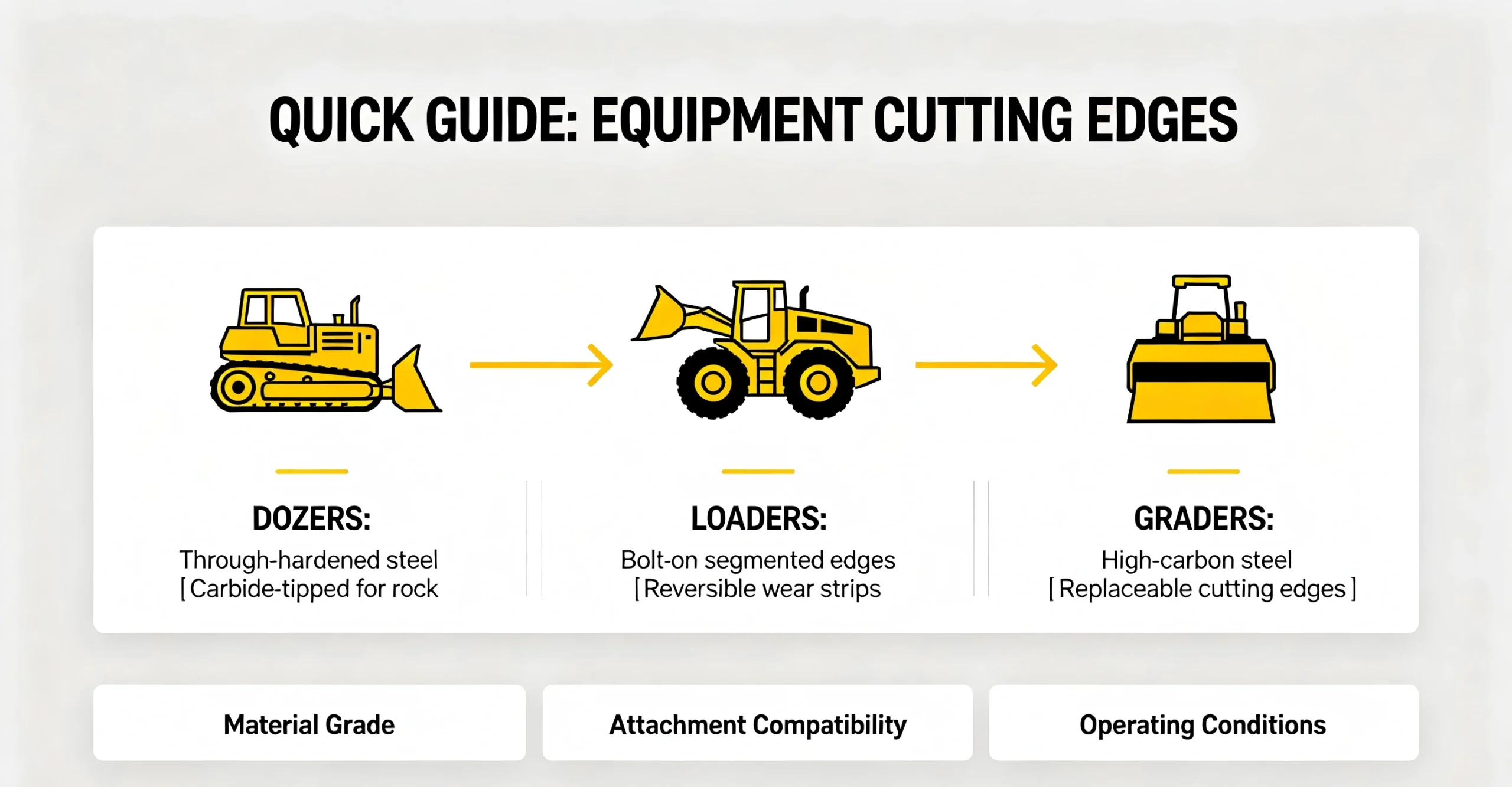
For dozers (bulldozers): Choose through-hardened steel blades for general pushing; use carbide-tipped edges for abrasive rock applications.
For loaders (wheel loaders): Bolt-on segmented cutting edges with reversible wear strips offer the best cost-per-ton.
For graders (motor graders): Choose high-carbon steel moldboard blades with replaceable cutting edges—and always check the curvature match to your moldboard.
But that’s just the starting point. The real decision involves three deeper factors: material grade, attachment compatibility, and operating conditions.
2. Why This Guide Exists (And Why Most Advice Is Outdated)
Search for “dozer blades” or “grader cutting edges” and you’ll find hundreds of product pages. Most list specifications. Few explain how to choose.
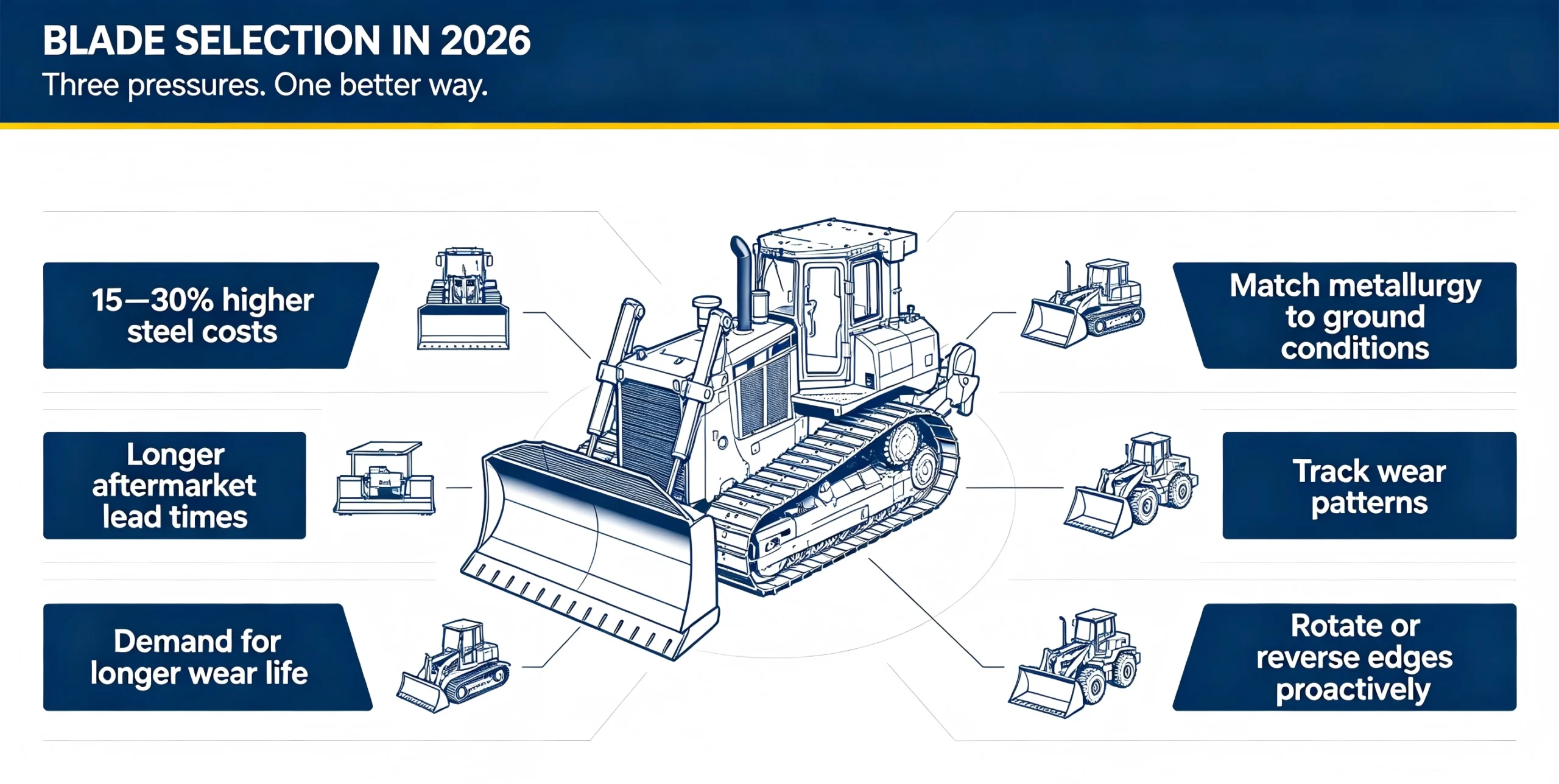
In 2026, equipment managers are facing:
15-30% higher steel costs compared to 2023
Longer lead times for aftermarket parts
Tighter maintenance budgets that demand longer wear life
The old approach — buy whatever the local dealer stocks, replace when worn, repeat — no longer works financially.
The new approach — match blade metallurgy to ground conditions, track wear patterns, and rotate or reverse edges proactively — saves 20-40% in annual consumable costs.
This guide is organized the way you actually make a decision: by machine type, by ground condition, and by budget.
3. For Dozers (Bulldozers): Straight Blades, U-Blades, and Angle Blades
What You Need to Know First
Dozer blades take the most punishing impact of any earthmoving attachment. They push, pry, and penetrate. The cutting edge (the replaceable strip at the bottom) absorbs 80% of the abrasion.
Three Blade Types Explained
| Blade Type | Best For | Cutting Edge Style |
|---|---|---|
| Straight Blade (S-Blade) | Fine grading, backfilling | Straight, single-piece edge |
| Universal Blade (U-Blade) | Moving large volumes, stockpiling | Curved, wider edge with end bits |
| Angle Blade (A-Blade) | Ditching, side-casting | Angled edge with replaceable corner bits |
Material Choice Matters Most
Through-hardened steel (400–500 BHN): Best for general earth, clay, and mixed soils. Provides good impact resistance and wear life.
Carbide-inserted edges: Best for rocky ground, quarry work, and blasted rock. Costs 2x more but lasts 4–5x longer.
Dual-density edges: Hard face on the wear surface, tough core underneath. The sweet spot for most contractors.
4. For Loaders (Wheel Loaders): Segmented Edges and Bolt-On Systems
The Unique Challenge of Loaders
Loaders don’t just push — they dig, scoop, and dump. The cutting edge takes abrasion from both the bottom (when digging) and the top (when dumping).
Cutting Edge Configurations
| Configuration | Application | Advantage |
|---|---|---|
| Straight edge | Light-duty, asphalt work | Low cost, easy replacement |
| Spade nose edge | Aggressive digging in hard ground | Better penetration, self-sharpening profile |
| Segmented (bolt-on) edge | Heavy quarry and mining work | Replace only worn sections, not the whole edge |
| Reversible edge | General purpose | Flip when worn — 2x life from one purchase |
The Cost-Per-Hour Calculation
Most buyers look at purchase price. Smart buyers look at cost per hour.
Example:
Standard edge: $450, lasts 200 hours → $2.25/hour
Premium carbide edge: $1,200, lasts 900 hours → $1.33/hour
The premium edge saves $0.92 per operating hour. On a loader working 2,000 hours/year, that’s $1,840 annual savings per machine.
5. For Graders (Motor Graders): Moldboard Blades and Curvature Match
Why Graders Are Different
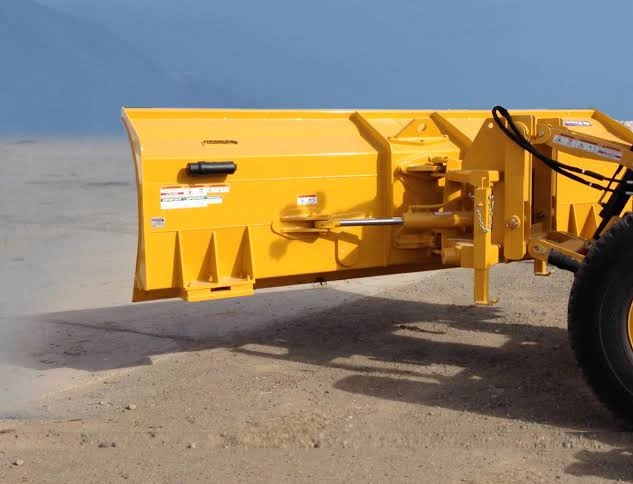
Grader blades do two jobs at once: cut and carry material. The cutting edge must match the moldboard’s radius exactly. A mismatch causes:
Uneven wear patterns
Poor grade quality
Premature moldboard damage
Grader Blade Types
| Blade Grade | Hardness (BHN) | Best Use |
|---|---|---|
| Standard carbon | 200–300 | Light grading, snow removal |
| High-carbon steel | 350–450 | Road maintenance, gravel work |
| Tungsten-carbide overlay | 500+ | Extreme abrasion, rock, and reclaimed asphalt |
The “Reversible Edge” Advantage
Most grader cutting edges are reversible — when the bottom edge wears, you flip the blade 180° and use the fresh edge. That’s two lives from one blade.
Critical check: Always confirm the bolt hole pattern matches your moldboard. The two most common patterns are:
5/8″ bolts on 6″ centers (standard for Caterpillar)
3/4″ bolts on 8″ centers (standard for Deere and Volvo)
6. The Three Universal Rules (Applies to All Machines)
Regardless of machine type, these rules govern every smart cutting-edge decision:
Rule 1: Match Hardness to Ground Conditions
| Ground Type | Recommended Hardness |
|---|---|
| Sand, topsoil | 300–400 BHN |
| Clay, mixed soil | 400–500 BHN |
| Gravel, crushed rock | 450–550 BHN |
| Limestone, granite | 500+ BHN (carbide recommended) |
Important: Harder is not always better. In impact-heavy applications (boulders, demolition), a tougher but slightly softer steel outperforms a brittle high-hardness edge that chips and fractures.
Rule 2: Inspect Wear Patterns Weekly
Check three things every 40 operating hours:
Edge thickness — measure at the center and both ends. Uneven wear indicates improper angle or tilt settings.
Bolt torque — loose bolts cause edge movement, which ovalizes bolt holes and ruins the adapter.
Reverse or rotate — flip reversible edges when wear reaches 50% of original thickness.
Rule 3: Never Run a Blade Down to the Adapter
Once the cutting edge wears below 1/4″ (6mm) thickness, replace it immediately. Running worn edges damages the adapter (the base that holds the edge), turning a $500 part replacement into a $5,000 repair.
7. Common Mistakes That Cost You Money
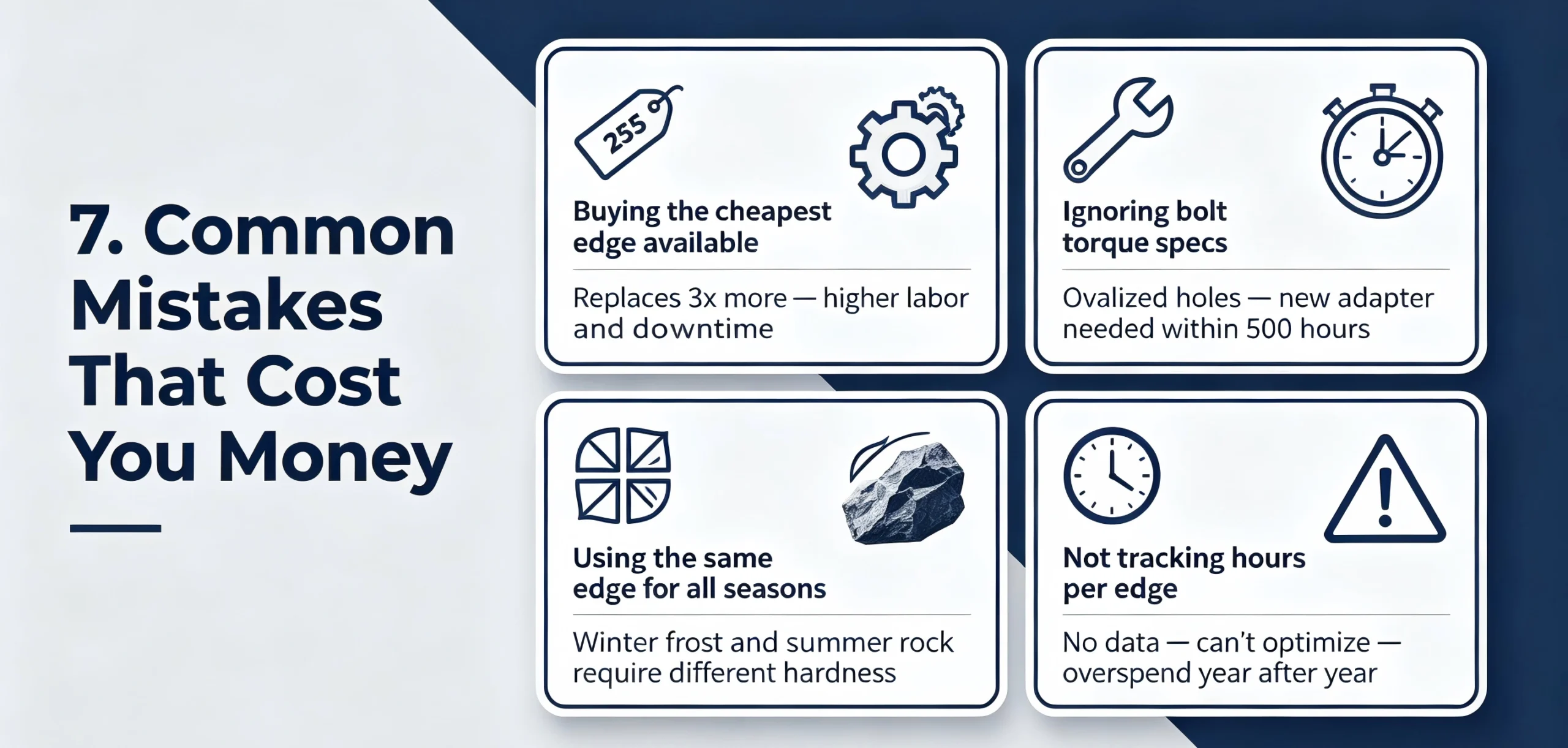
| Mistake | True Cost |
|---|---|
| Buying the cheapest edge available | Replaces 3x more often — higher labor and downtime |
| Ignoring bolt torque specs | Ovalized holes → new adapter needed within 500 hours |
| Using the same edge for all seasons | Winter frost and summer rock require different hardness |
| Not tracking hours per edge | No data → can’t optimize → overspend year after year |
8. Action Plan: Your 5-Step Selection Process
Step 1 — Identify your primary ground type
Take photos of your job site. Are you in sand, clay, gravel, or rock? Be honest.
Step 2 — Check your machine specifications
Dozer: blade type (S/U/A) and pin configuration
Loader: bolt pattern and edge length
Grader: moldboard radius and bolt hole spacing
Step 3 — Set a cost-per-hour target
If you don’t track this now, start today. Record edge purchase price + installation labor ÷ total hours until replacement.
Step 4 — Choose material grade based on Step 1
Use the hardness chart in Section 6. When in doubt between two grades, choose the tougher (not hardest) option.
Step 5 — Buy one premium edge as a test
Run it alongside your standard edges. Track hours. Compare cost-per-hour after both are worn out. Let the data make your future decisions.
9. FAQ (Quick Answers to Common Questions)
Q: Can I use the same cutting edge on a dozer and a loader?
A: No. Dozer edges are thicker and designed for straight-line pushing. Loader edges have different bolt patterns and curvature for bucket digging.
Q: How often should I replace cutting edges?
A: When the edge reaches 25–30% of its original thickness. Running beyond that damages adapters.
Q: Are aftermarket blades as good as OEM?
A: Many aftermarket brands exceed OEM quality — but only if they specify hardness grade and steel source. Always ask for material certifications.
Q: What’s the best way to store spare cutting edges?
A: Keep them off the ground, stacked flat, and coated with light oil to prevent rust. Avoid temperature extremes.
10. Summary: What Matters Most in 2026
| Factor | Priority Level |
|---|---|
| Material hardness match to ground | ★★★★★ |
| Cost-per-hour tracking | ★★★★☆ |
| Bolt torque maintenance | ★★★★☆ |
| Brand name | ★★☆☆☆ |
| Price per edge (alone) | ★★☆☆☆ |
The bottom line: The best cutting edge isn’t the most expensive or the cheapest — it’s the one that gives you the lowest cost per hour in your specific ground conditions.
11. Next Steps
Audit your current edges — record hours, wear patterns, and purchase prices
Test one premium option against your standard edge and track data
Standardize on the winning configuration across your fleet
Final Thought: Cutting edges are consumables — they’re meant to wear out. But how quickly they wear out is largely within your control. Match the metal to the ground, track the data, and replace proactively. Your maintenance budget will thank you.